
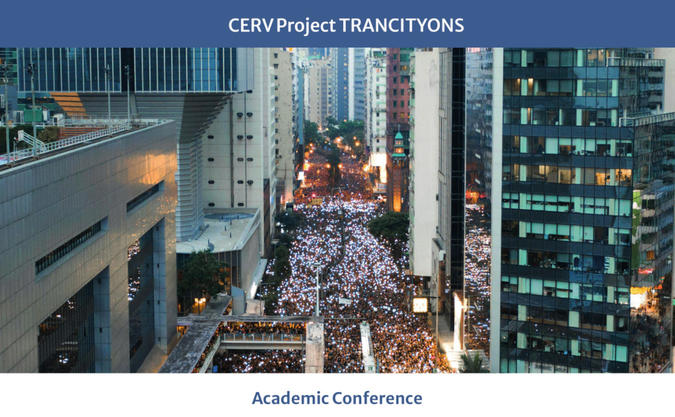
Academic Conference “Trancityons. Democratic transitions in urban contexts can lead to the emergence of new norms and, potentially, new urban forms” organised by Alma Mater Studiorum Università di Bologna.
The “Trancityons” project aims to foster a new awareness of the role of urban space in democratization processes. By examining cities as dynamic centres of diverse identities, religions, and social dynamics, the project explores how urban environments can drive democratic change or resist authoritarian tendencies.
The historical and comparative perspective focuses on democratic transitions in Italy after World War II and Eastern Europe and post Yugoslav wars. This analysis provides insights into the development of national democratic systems and the promotion of European Union principles, aiming to explore the role of urban contexts in democratic transitions, emphasizing the importance of memory in understanding present phenomena.
This will be achieved through a diverse range of activities and strategies. Specifically, academic research will be complemented by constant citizen engagement, including their involvement in the investigative activities, such as the surveys conducted in Italy and Poland. Additionally, the project includes a series of activities aimed at engaging European citizens, such as traveling exhibitions in Serbia, Bosnia and Herzegovina, and Croatia, as well as public debates and workshops. These workshops will specifically highlight the role of women in democratic transitions, viewed through the lens of urban contexts.
By studying democratic transitions, the project aims to understand how urban realities, characterized by a mix of interests and identities, contribute to disseminate European values and to the constitutional and institutional evolution. Therefore, cities will be the lens through which to look at the democratic transitions of yesterday, today, and tomorrow. The changes in urban contexts, indeed, are crucial signals for understanding the paths that modern European democracies have embarked upon and what knowledge needs to be protected and promoted.
PROGRAMME
Ore 09:30 – Participants registration
Ore 10:00 – Institutional Greetings
Emanuela Carbonara, Deputy Head of the Sociology and Business Law Department, Università di Bologna
Ore 10:15 – Opening Remarks
Claudia Golino, PI of the Trancityons Project, Università di Bologna
Ore 10:30 – 1st Panel | Cities&Democratic Transitions: the importance of memory
Michele Belletti, Chair, Università di Bologna
Paulus Albertus Blokker, Università di Bologna
Corrado Caruso, Università di Bologna
Giulia Prandini, MondoDonna
Ore 11:45 – 2nd Panel | Cities Promoting EU Values: the role of local dimensions in defending the rule of law
Claudia Golino, Chair, Università di Bologna
Federico Ferri, Università di Bologna
Luca Sparnacci, Unione delle Province d’Italia – Emilia-Romagna
Olivia Pini, Università di Bologna
Ore 13 – Lunch Break
Ore 14:30 – 3rd Panel | Cities as Drivers of Democracy from a cognitive perspective: do we imagine democracies as urban contexts?
Corrado Roversi, Chair, Università di Bologna
Chiara Valentini, Università di Bologna
Luisa Lugli, Università di Bologna
Ewa Laskowska-Litak – Michalina Szafrańska, Jagellonian University
Ore 16:00 – 4th Panel | Cities & Democratic Transitions Beyond the EU: lessons learned and future challenges
Olivia Pini, Chair, Università di Bologna
Leonardo Pasqui, Università di Bologna
Marco Abram, Osservatorio Balcani Caucaso Transeuropa
Fiorella Spizzuoco-Miriam Viscusi, Lo Spiegone
Ore 17:30 Final Remarks
Federico Casolari, Head of Department of Legal Studies, Università di Bologna
INFO:
Università di Bologna
Page Trancityons Project